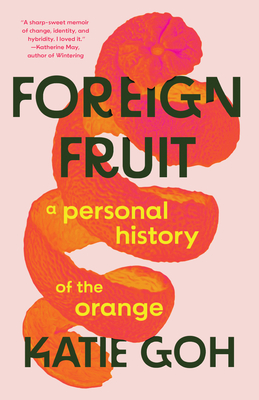
“A sharp-sweet memoir of change, identity and hybridity. I loved it.”—Katherine May, author of Wintering
Per person, oranges are the most consumed fruit in the world. Across the world, no matter how remote or cold or incongruous a climate is, oranges will be there.
What stories could I unravel from the orange's long ribboning peel? What new meanings could I find in its variousness, as it moves from east to west and from familiar to foreign?
What begins as a curiosity into the origins of the orange soon becomes a far-reaching odyssey of citrus for Katie Goh. Katie follows the complicated history of the orange from east-to-west and west-to-east, from a luxury item of European kings and Chinese emperors, to a modest fruit people take for granted. This investigation parallels Katie’s powerful search into her own heritage. Growing up queer in a Chinese-Malaysian-Irish household in the north of Ireland, Katie felt herself at odds with the culture and politics around her. As a teenager, Katie visits her ancestral home in Longyan, China, with her family to better understand her roots, but doesn’t find the easy, digestible answers she hoped for.
In her mid-twenties, when her grandmother falls ill, she ventures again to the land of her ancestors, Malaysia, where more questions of self and belonging are raised. In her travels and reflections, she navigates histories that she wants to understand, but has never truly felt a part of. Like the story of the orange, Katie finds that simple and extractable explanations—even about a seemingly simple fruit—are impossible. The story that unfolds is Katie’s incredible endeavor to flesh out these contradictions, to unpeel the layers of personhood; a reflection on identity through the cipher of the orange. Along the way, the orange becomes so much more than just a fruit—it emerges as a symbol, a metaphor, and a guide. Foreign Fruit: A Personal History of the Orange is a searching, wide-ranging, seamless weaving of storytelling with research and a meditative, deeply moving encounter with the orange and the self.
About the Author
Katie Goh is a writer, editor and author from the north of Ireland, currently living in Edinburgh.
Praise For…
The book certainly goes deep on the popular citrus and its central role in international trade, from its origins in the ancient world to its present ubiquity. But the journalist, like the orange, has ancestral roots that span the globe, and here the juicy fruit reveals still another valence — as a lens on the world, and a layered metaphor for Goh's past and our collective future. — NPR
This book sounds like it perfectly sums up the best parts of a great microhistory: a niche topic you’ve always loved written by a relatively new and talented writer. — Scientific American
Elegant...Goh refuses simple stories, instead conjuring a complex, finely woven exploration of the citrus and the self. — NPR Books
A really beautiful story with incredible writing. For people who love memoir, history, food stories… it’s just excellent. — Book Riot
A blend of memoir and criticism that explores a topic in a way I never encountered. Goh’s writing is inventive and intelligent. — Debutiful
You’ll want to peel back the layers and savor to the last page. — Chicago Review of Books
Documenting the orange across time and space, Foreign Fruit is a powerful meditation on the relationships between commodities and colonialism, place and produce, self and history. — Full Stop
The orange has a complicated history, which Katie Goh unravels exquisitely in this hybrid memoir. — Autostraddle
Wildly inventive. — Orange County Register
Lyrical and biting and rife with irresistible citrus facts and peripatetic insights, Goh's narrative intricately grafts private and global narratives into a singular literary achievement. — Booklist
Stunning…. Goh navigates notions of hybridity, immigration, colonization, commerce, belonging, family, violence and myth. She masterly splices and grafts together these thematic elements and histories into an energetic, illuminating, well cultivated memoir. — West Trade Review
She moves easily among her research, the fruit’s complicated past, and her own heritage….Those who claim both history and memoir as favorite genres are likely to adore this hybrid work. — Bookpage
A sharp-sweet memoir of change, identity and hybridity. I loved it. — Katherine May, author of Wintering
Foreign Fruit offers one of the strongest openings of a non-fiction book I've read in a long time, refusing history to stay at a distance and the trade wealth is built on to remain elusive, subverting the popular genre of the 'history of things' in elegant ways. Katie Goh writes with as admirable a preciseness about self-othering as she does about botanical history. What's more, she injects her memoir writing with an essential critique and awareness of what it means to turn your own pain into a commodity as a person of colour in a white-dominated media landscape, and as a writer of mixed belongings in a market that seeks to routinely label. — Jessica Gaitán Johannesson, author of The Nerves and Their Endings and How We Are Translated
Foreign Fruit is an encounter not only with the orange, but with the reality of diasporic life in hostile environments. Goh patiently and skilfully reinvents the orange as a means of inventing her identity, finding ways to grow and claim a story beyond which she'd first thought was hers to take. And what we're given is a story more surprising, potent, and various than we could ever have imagined. — Amy Key, author of Isn’t Forever and Arrangements in Blue
I don't know anyone who wouldn't love this book. Airy and rooted, its style as beautiful as its investigations, this is the kind of book that holds in it the unexplored ecosophical inquiries of our time. — Sumana Roy, author of Provincials: Postcards from the Peripheries
Beautiful, visceral and powerful writing that speaks from the heart and to the heart. I could feel every word: the frustration, the confusion and the joy. Foreign Fruit is a raw and fascinating book that delves into the important meaning of fruit that we take for granted every day, as well as the history of fruit in Asian cultures. I absolutely adored it. — Angela Hui, author of Takeaway